The olive harvest in Florence: from the olive grove to the mill
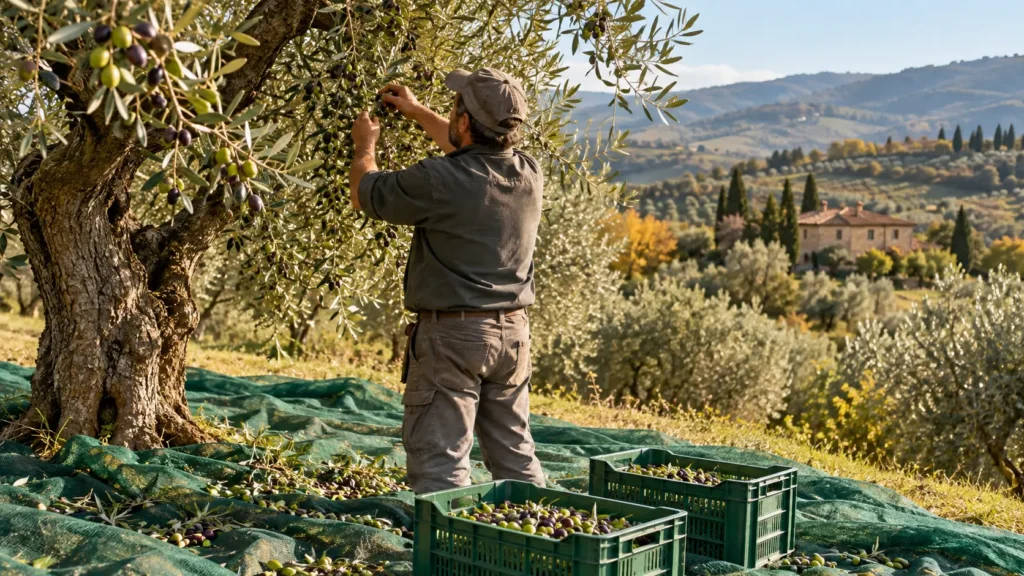
In autumn, among the silvery branches of the olive trees, the Florentine countryside changes pace. Nets are spread beneath the canopies, crates fill up and the work moves on towards the mill. The olive harvest in Florence reveals a tangible bond between landscape, farming and cooking: a journey that ends with new olive oil arriving on the table.
To understand it, it is worth following every step. The timing of the harvest, the care of the fruit and the processing all contribute to the final result, together with the olive variety and the course of the season.
When are olives harvested in Florence?
In Tuscany, October and November are the months most closely associated with the olive harvest. In the Florentine area they are therefore a point of reference for discovering this activity and the arrival of new olive oil. There is, however, no single date for every olive grove: the actual calendar changes with each year and with the producer’s choices.
Source: Visit Tuscany, events and seasons in Tuscany (in Italian).
Deciding when to start means observing the olives and considering the kind of oil you want to obtain. Ripening does not proceed in the same way on every tree: exposure, variety and local conditions make every harvest different. For anyone wishing to witness it, contacting the farm directly is the best way to find out when the work takes place.
The olive groves around Florence
To step into this landscape, you only need to leave the city and head towards the hills. In Bagno a Ripoli, between Florence and Chianti, olive groves, vineyards, farmhouses and cypress trees make up a countryside where farming is part of the local identity.
Source: Visit Tuscany, Bagno a Ripoli.
Another link between oil and territory can be found in Impruneta: its terracotta tradition includes the making of the large jars, known as orci, used to hold oil and wine. Even an object can show how deeply olive growing has become part of everyday life in the Florentine countryside.
Source: Visit Tuscany, Impruneta (in Italian).
The harvest: from the canopy to the nets
The work begins by preparing the ground beneath the trees and laying out the nets. The olives are detached from the branches and then gathered to be transferred into containers. In hand-picking, known in Italian as brucatura, the fruit is removed by hand; other methods use harvesting aids or machinery, chosen according to the olive grove.
For Toscano PGI olive oil, the fruit can be picked directly from the tree by hand or by mechanical means. This step helps explain how much the origin of the raw material and the management of the harvest matter.
Source: Visit Tuscany, Toscano PGI extra virgin olive oil (in Italian).
Watching a day in the olive grove also reveals the value of organisation: setting out nets and crates, coordinating the work among the trees and scheduling delivery to the mill are all part of the same process. In a sense, the harvest continues even after the last olive has left the branch.
From the olive grove to the mill: time matters
Olives are perishable fruit. For this reason, the Region of Tuscany recommends keeping the wait before crushing to a minimum: its 2025 technical guidelines speak of less than 24 hours for perfectly healthy olives and just a few hours for those more affected by pests or pathogens. This is not a waiting time, but a reminder of the need for prompt processing.
While they wait, the olives should be placed in clean, perforated plastic crates, in shallow layers, in cool and well-ventilated spaces. Sacks, piles on the ground and exposure to the sun should be avoided; olives that have already fallen and lain on the ground should not be collected for milling either.
Source: Region of Tuscany, advice on harvesting and storing olives, 2025 (in Italian).
For producers, booking a slot at the mill before starting helps coordinate harvesting and processing. For visitors, following the journey of the crates makes a simple principle visible: quality is also built in the least conspicuous steps.
How an olive mill works: from olives to oil
Arriving at the mill marks the shift from work in the fields to transformation. The scent changes, the machinery sets the rhythm of the operations, and what was a whole fruit just moments before becomes first a paste and then oil.
1. Cleaning and washing
Leaves and foreign matter are removed and the olives are washed. This preparation comes before the processing itself.
2. Crushing
The olives are crushed to obtain a paste. The crusher breaks down the tissue of the fruit and prepares the material for the following stages.
3. Malaxation
The paste is slowly mixed in the malaxers. The movement helps the tiny droplets of oil come together, making extraction easier; time and temperature are processing parameters to be managed with care.
4. Separation
In modern mills, centrifugation separates the oil from the other components of the paste, including water and solids. The configuration of the machinery can vary from one mill to another.
Source: Regional Council of Tuscany, publication on olive processing (in Italian).
5. Filtration and storage
Filtration removes the water and solid residues still present in the oil. Watching the oil flow from the machinery is an evocative moment, but the process continues with the operations that prepare it for storage and consumption.
Source: Visit Tuscany, how Tuscan extra virgin olive oil is made.
At the mill, it is worth asking the producer to explain the choices made for the batch of olives just processed. The visit then becomes an opportunity to understand the work and the link between harvest, processing and taste.
The first taste of new olive oil
The journey ends at the table. New Tuscan olive oil can be discovered starting from its aromas: the notes described for the region’s extra virgin oils include almond, artichoke, freshly cut grass and ripe fruit. Every bottle can express a different balance.
Source: Visit Tuscany, the green gold of Tuscany (in Italian).
For a first tasting, try it on its own and then on a slice of toasted bread. Fettunta offers an essential pairing, while a raw drizzle over ribollita, beans or vegetables lets you explore its effect on the dishes of local cuisine.
Once you are home, storage also deserves attention: keeping the oil away from light and sources of heat, in a cool and dry place, helps respect the conditions recommended for the product.
Source: Consorzio Olio Toscano IGP, storage guidelines (in Italian).
Frequently asked questions
How long does it take from harvest to crushing?
The aim is to process the olives as soon as possible. The regional guidelines mentioned above recommend keeping the wait to a minimum, taking into account above all the condition of the fruit and the temperature.
Can you visit an olive mill during the harvest?
Visitor access and available times need to be checked directly with the mill. An olive mill is a place of work, and welcoming visitors has to be coordinated with production.
What makes this journey special?
Following the olives from the hills to the mill lets you read the landscape through what it produces. Bread and oil then become the meeting point between a season, the work of those who tend the trees and a land to be discovered through its flavours too.